Immigration & Homesteading
1751 to 1796
This page follows the Kessler family from its arrival in America in 1751 through the major family transition of 1796. It traces the journey from Germany to Maryland, the establishment of the Frederick County homestead, the family’s growth during the colonial and Revolutionary eras, and the circumstances that eventually led Andreas and several sons west to Pennsylvania.
The narrative is arranged chronologically. Each section introduces the major developments of the period, while the expandable notes provide additional historical context, records, maps, and research details.
The Journey to America, 1751
In 1751, Johann Georg Bernhard Kessler, his wife Anna Catharina Hauswirth, and their children left southwestern Germany for the British colonies in North America. After arriving in Philadelphia, the family traveled inland to Frederick County, Maryland, where they established a farm near what is now Jefferson Township.
Departure from Winden via Amsterdam
At the territorial archives in Speyer, Germany, a handwritten document was found authorizing the Kessler family’s 1751 emigration to America. The record states:
“Catharina Kessler, maiden name Hauswirth, of Winden, is traveling with her husband and four children to America.”
The document relates to residents of villages within the Duchy of Zweibrücken and provides unusually direct evidence of the family’s planned emigration. Although Catharina is named in the record, her husband, Johann Georg Bernhard Kessler, is not identified by name. The family nevertheless can be followed through later records as they made their way toward Amsterdam and passage to America.
In 1751, George Bernhard, his wife Anna Catharina Hauswirth Kessler, and their family traveled from Winden to Amsterdam, a journey of approximately 275 miles. Catharina’s younger brother, Johann Jacob Hauswirth, also accompanied them. From there they sailed for America aboard the ship Janet, arriving in Philadelphia on October 5, 1751.
Three surviving children traveled with their parents: Johannes, Andreas, and Susanna. A son, Isaac, had died in Germany in 1747. A daughter, Anna Margaretha, was born in Maryland in 1753.
Crossing the Atlantic & Arrival in Philadelphia
Johann Georg Bernhard Kessler, Anna Catharina Hauswirth Kessler, their children, and Catharina’s brother Johann Jacob Hauswirth sailed for America aboard the Janet, arriving in Philadelphia on October 5, 1751.
Philadelphia was the family’s point of entry into the British colonies, but not their destination. After landing, they continued south and west toward Frederick County, Maryland, where a growing German-speaking population and members of their extended family offered familiarity, contacts, and opportunity.
From Philadelphia to Frederick County, Maryland
George Bernhard’s second cousins, Frantz and Abraham Weiss, had immigrated to America nearly two decades earlier. They arrived in 1733, first settling in Lancaster, Pennsylvania, before moving south into the Maryland settlement known as Tasker’s Chance.
Frantz Weiss became part of the growing German community there. He appears in Maryland records as Francis Wise and was among German settlers associated with efforts to acquire land in the Tasker’s Chance tract during the 1730s.
By the time George Bernhard and his family arrived in Philadelphia in 1751, these relatives were already established in the Frederick area. Their presence gave the newly arrived Kesslers a family connection in Maryland and likely made Frederick County a natural destination.
George Bernhard and his family subsequently settled west of Frederick Town, near what later became Jefferson, beginning the Maryland chapter of the Kessler family story.
Arriving in Maryland and Establishing a Homestead, 1751-1753
Over the next forty-five years, that homestead became the center of family life. Johann and Anna Catharina raised their children there, the family became part of a growing German-speaking community, and the next generation came of age during a period of enormous change that included the French and Indian War, the American Revolution, and the creation of the new United States.
Historical Context: Colonial America and Frederick, Maryland
The story of early German settlement in western Maryland begins farther north, in Pennsylvania. Beginning in the late seventeenth century, William Penn and his representatives encouraged immigration from the Netherlands and the German states. Large numbers of German-speaking immigrants settled in Pennsylvania, and by the early eighteenth century established German communities were spreading westward and southward.
As Pennsylvania land became more expensive many German immigrants looked beyond Pennsylvania for affordable farmland. In 1730, Lord Baltimore offered 200 acres in western Maryland to those willing to establish residence. Such incentives helped draw settlers south from Pennsylvania and into western Maryland.
A 7,000-acre tract was surveyed in 1725 and two years later was named Tasker’s Chance. Frederick County was established in 1748. Frederick Town was laid out within the Tasker’s Chance tract, developed rapidly, and attracted German-speaking settlers moving south and west from Pennsylvania.
Settling in Frederick County, Maryland
It is likely that Johann’s cousins, who had arrived over a decade earlier, encouraged him to settle in Frederick County. Johann, as the youngest son, did not stand to inherit or take over family activities in Germany and likely convinced his wife that emigrating would provide for a better life.
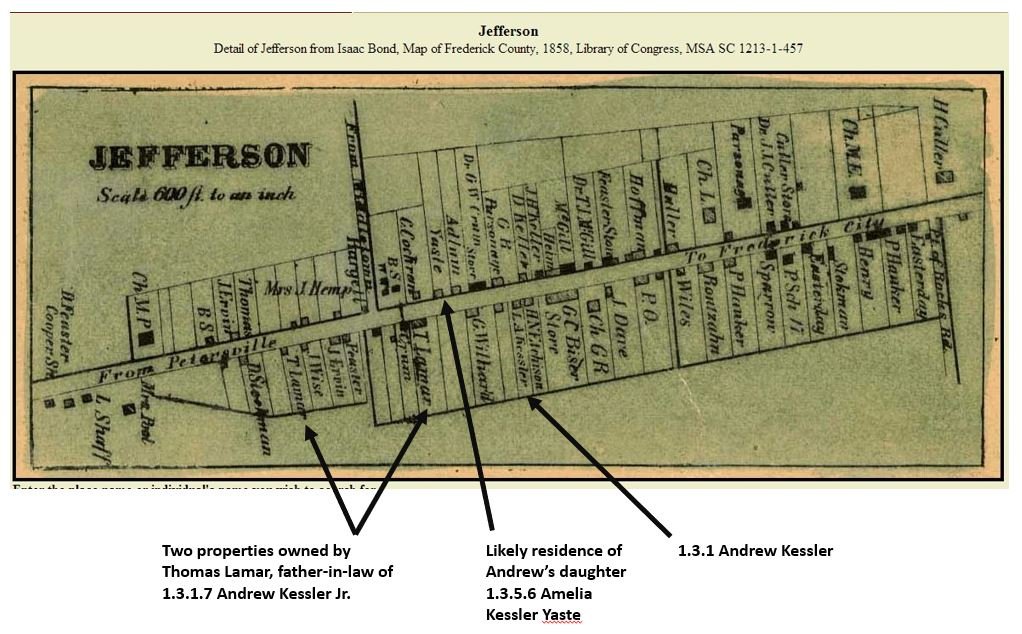
It is not known whether they received land from Lord Baltimore or purchased it. Their new homestead was located six miles west of Frederick in a community that would eventually be known as Jefferson.
The road from Frederick to Jefferson was a wagon road that eventually became Jefferson Pike (MD 180), connecting Frederick to Brunswick, Maryland. The family land was located about a mile off of Jefferson Pike, along what is now Lander Road.
Jefferson’s main town area was organized into a series of rectangular lots along Jefferson Pike. Jefferson was the location of a large number of taverns. Jefferson’s growth in the 19th century was due largely to traffic along Jefferson Pike.
The Early Years (1751-1753)
Frederick Town was first laid out in 1745, carved out of a 7,000-acre tract known as “Tasker’s Chance.” It grew rapidly before the Kessler family arrived in 1751.
Frederick County was a welcoming place for German immigrants because there were a large number of other Germans residing there. Many residents and business owners spoke German and there were a number of German speaking churches in the area. The first generation of immigrants likely continued speaking German and knew only enough English to conduct basic business transactions. The immigrant children, over time, learned English and became bilingual.
The new homestead was located six miles west of Frederick Town along a dirt road that went from Frederick to Brunswick, Maryland, on the Potomac River. The family likely stayed with the Weiss family when it first arrived commuting between Frederick and the new farm.
Provisions could be purchased in Frederick and transported while the family cleared trees and erected structures that the family would occupy for the next 150 years. When habitable structures were ready, the family likely moved to the farm, set up the household, and started operating the farm.
The Kessler family arrived at their homestead near present-day Jefferson, Maryland in 1751. They likely spent the fall, winter and spring clearing the land, working rapidly to get the land ready for planting in 1752. In addition to clearing the land the family had to erect a living structure, likely a crude log cabin, and construct a fenced area and barn for animals necessary to provide family with basics such as eggs, milk, and other animal-based products.
Life on the Maryland Homestead, 1753-1768
During the fifteen years after the homestead was established, the Kessler family became increasingly rooted in Frederick County. Johann and Anna Catharina raised their children on the farm, while Johannes and Andreas grew from boys into young men and gradually assumed greater responsibilities. The family also became part of the surrounding German-speaking community. These years were not isolated from larger events: the French and Indian War brought conflict to the western frontier, while political tensions with Britain began to reshape life throughout the colonies.
Establishing Roots
The American colonies were prospering, and their combined population exceeded 1.5 million by the time the Kessler family started farming west of Frederick Town, near what later became Jefferson. Frederick was heavily populated by German immigrants. It was possible to attend churches where services were conducted entirely in German and to interact with many who also spoke the language.
When the family arrived in 1751, Johannes was nine years old and Andreas was five years old. As Johann began clearing land and operating his farm, his two sons most certainly helped their father with farm chores and activities.
The 1760s were likely a time of prosperity and economic success for the Kessler family as their farm matured and the colonial economy expanded. Andreas and Anna Marie Rehman married in October 1768, and it is likely that older brother Johannes married during this decade as well.
Historical Context: War & Growing Colonial Tensions
The timing of their arrival made their experience uniquely dangerous. The 1750s were not a peaceful era of quiet homesteading; they marked the eruption of the French and Indian War (1754–1763).
Immigrants that settled on the extreme western edge of the colonies were sitting directly on the front lines of a global conflict. Native American nations, allied with the French and desperate to push the British colonists out of their hunting grounds, launched devastating raids throughout the backwoods of Pennsylvania and Virginia.
Many isolated German homesteads were burned, crops were destroyed, and families were killed or taken captive. Settlers frequently had to abandon their hard-won farms to huddle in hastily constructed community blockhouses or flee eastward until the violence subsided in the late 1750s.
Fortunately, the Kessler homestead was not located on the frontier where war was raging. While the family likely heard stories of raids and attacks, it was largely removed from the violence and able to focus on building a home, outbuildings, and farm land.
Other major historical events that would shape the future of their new country were happening during the second half of the 18th century, but it is likely that the family’s location in the countryside outside of Frederick Town, limited understanding of the English language, and the challenge of establishing an economically viable farm consumed most of their time, effort, and attention.
Events during the 1760s, as Johannes and Andreas grew to adulthood, set the colonies on a path to revolution. George III ascended to the throne in 1760 and appointed political leaders who favored a stricter policy toward the American colonies. This resulted in passage of the Sugar Act in 1764 and the Stamp Act and the Quartering Act in 1765. By mid-1765, colonial activists and political bodies were actively protesting “taxation without representation” and the protests grew violent. While the Stamp Act was repealed in 1766, the Townshend Acts were enacted in 1767, imposing duties on glass, tea, and other items imported into the colonies. The Americans reacted by adopting non-importation agreements and refusing to buy British goods. Formal and informal protests and objections continued through the remainder of the 1760s. The stage was set for the events that followed in the 1770s.
Farming & Household Life
For German immigrants arriving in the 1750s, the western frontiers of Pennsylvania, Maryland, and Virginia’s Shenandoah Valley were a jarring contrast to the heavily cultivated farmlands of Europe. They traded the established, manicured fields of the Palatinate and the Rhineland for dense, old-growth wilderness, often arriving with nothing but debt and hand tools.
The immediate hurdle was the timber. The eastern woodlands were so dense that settlers couldn’t simply start plowing.
Instead of chopping down entire forests at once—which was impossible for a single family—Germans adopted the Native American practice of girdling. They used axes to strip a ring of bark from the base of a tree, cutting off its nutrient supply. The tree would die and shed its leaves, allowing sunlight to reach the forest floor. Families planted their first crops of corn and squash directly among the dead, standing trees. Over the next few years, they would fell the dead timber, burn the brush, and undertake the backbreaking work of pulling the stumps by hand or with oxen to create open fields.
German farmers were known for their meticulous agricultural practices. Unlike some settlers who rapidly exhausted the soil, Germans practiced crop rotation and heavy manuring to keep the land fertile.
Because traditional European crops like wheat and rye were difficult to grow among the stumps of a new clearing, they quickly adapted to growing Native American maize (corn). Corn produced a massive yield per acre, could feed both the family and the livestock, and grew easily in rough, newly cleared soil. As the fields were fully cleared, they transitioned back to wheat, eventually turning the mid-Atlantic backcountry into the “breadbasket” of the colonies.
Family Records in Colonial America
George Bernhard and his family appear in church records until 1789. Some records suggest that he fought Indians in Frederick, Maryland under a Captain Peter Butler. He did not collect what had been owed him for his last days of active duty until 1768. He owned land in Tasker’s Chance, now Frederick, Maryland and was naturalized in 1759 in Annapolis, Maryland.
The Next Generation Comes of Age, 1768–1776
The year 1768 marked an important transition for the Kessler family. Anna Catharina died that year, while Andreas, now a young adult, married Anna Maria “Mary” Rehman and began building a household of his own. Johannes was also ran adult, and both sons increasingly took on responsibilities that had once rested primarily with their father.
Johann George Bernhard Kessler remained the head of the extended family, but the balance was beginning to shift. The farm was no longer simply an immigrant homestead occupied by parents and children; it was becoming the center of a growing second generation, with adult sons, marriages, new households, and grandchildren.
At the same time, the colonies were entering a period of escalating political conflict with Britain. Events such as the Boston Massacre, colonial resistance to taxation, and the fighting that began in 1775 would have formed the broader setting in which the Kesslers built their lives. Little is known about the family’s political views, but by 1776 both the family and the colonies had entered a new era.
Family Leadership Transition
Johann was born on November 8, 1711, and by 1768 was approaching his late fifties. The death of his wife, Anna Catharina, that September at age 54 was likely a profound personal and practical loss after more than thirty years of marriage and the shared experience of leaving Germany and building a new life in Maryland.
His sons, Johannes and Andreas, were now adults and increasingly capable of taking on responsibilities associated with the farm and extended family. As the homestead matured and the family became more established, the balance of responsibility likely began to shift gradually from Johann toward the next generation.
Andreas and Mary Begin Their Family
Andreas married Anna Maria “Mary” Rehman in November 1768, only two months after the death of his mother. Andreas was 22 years old and Mary was 16.
Their family grew rapidly. Between 1770 and 1790 they had ten known children: Andrew, Johannes (John), Mary, George, Peter, Jacob, William, Samuel, Thomas, and David. All but one were born in Frederick County, linking the next generation firmly to the Maryland homestead.
What We Know About Johann and Anna Catharina’s Children
The family that arrived in 1751 consisted of Johann Georg Bernhard Kessler, his wife Anna Catharina, and their children Johannes, Andreas, and Susanna Catharine. A fourth surviving child, Anna Margaretha, was born in Maryland in 1753. Anna Catharina died in 1768 at age 54, leaving Johann a widower for the remaining 24 years of his life. There is no evidence that he remarried.
Little is known about the eldest son, Johannes, or John. He was born in 1742, came to America with the family, and remained in Frederick County. Church records identify daughters Anna Maria, baptized in 1766, and Margaret, born in 1775, to Johannes and Catharina Kessler. Because the family maintained connections with Middletown, it is possible that Johannes settled there after marriage.
Much more is known about Andreas, born in 1746, who eventually assumed a central role in the family’s Maryland homestead and later led part of the family west to Pennsylvania. His life and descendants are followed in detail elsewhere on the site.
Far less is known about the daughters. Susanna Catharine, born in 1749, largely disappears from the surviving record. Anna Margaretha, born in Maryland in 1753, appears later as a baptismal witness in Frederick County. Their incomplete records are a reminder of how much family history from the colonial period remains uncertain.
The Road to Revolution
During the late 1760s and early 1770s, tensions between Britain and the American colonies intensified. Measures such as the Sugar Act, Stamp Act, Quartering Act, and Townshend duties fueled opposition to British taxation and authority.
By the early 1770s, events such as the Boston Massacre and the growing colonial resistance movement had pushed the colonies toward open conflict. Fighting began in 1775, and in July 1776 the Continental Congress adopted the Declaration of Independence.
Little is known about the Kessler family’s political views during these years. Whatever their personal loyalties, they were living through a period in which the political order around them was being transformed.
War, Independence, and Family Growth, 1776–1790
The years from 1776 to 1790 brought enormous change both to the Kessler family and to the country around them. While the Revolutionary War unfolded and the former colonies struggled to create a new national government, the family continued the practical work of farming, raising children, acquiring land, and building a more established life in Frederick County.
During these years Andreas and Mary’s household grew rapidly, while Johann entered the later decades of his life. The Kessler family had now been in Maryland for more than a generation. What had begun as an immigrant homestead was becoming a network of related households whose members were increasingly rooted in the land and community around them.
Revolutionary-era Frederick County
Frederick County occupied an important position during the Revolutionary era. The region lay along major routes connecting the Mid-Atlantic colonies with western Maryland, Pennsylvania, and the Shenandoah Valley. Frederick Town became an important center for military movement, supplies, prisoners, and communication.
The war undoubtedly affected daily life through shortages, taxation, military service requirements, and the movement of troops and supplies. Yet the Kessler farm lay outside the major battle zones, and surviving records do not show that the family was directly involved in major military actions.
Little is known about the political loyalties of Johann, Johannes, or Andreas during the Revolution. In the absence of stronger evidence, the safest conclusion is that the family continued operating its farms and households while responding, like other rural families, to the economic and political disruptions of the war.
Family Growth & Landholding
The years of the Revolution were also years of rapid family growth. Andreas and Mary had begun their family in 1770, and during the 1770s and 1780s most of their children were born on or near the Frederick County homestead.
As the family expanded, land became increasingly important. Adult sons needed space for their own households, farming, livestock, and future children. Andreas and other family members appear in land and church records during these years, evidence that the second generation was becoming firmly established in the area.
By 1790, the Kesslers were no longer a single immigrant household. They had become an extended family consisting of multiple generations and emerging households. That growth brought prosperity and continuity, but it also created a practical problem that would become increasingly important in the 1790s: how could the available land support so many adult sons and their families?
From British Colony to United States
Independence changed the political world in which the Kessler family lived. The family had arrived in 1751 as subjects of the British Crown. By the 1780s, they were living in an independent republic governed first under the Articles of Confederation and then, after ratification of the Constitution, under the new federal government.
For rural families, many of the immediate concerns remained familiar: land, crops, taxes, roads, markets, churches, and local government. But the legal and political framework around them was changing rapidly. New governments had to resolve war debts, regulate commerce, establish taxation, and define the relationship between state and federal authority.
We do not know how closely the Kesslers followed these debates or what political opinions individual family members held. What is clear is that by 1790 the family that had arrived from Germany four decades earlier was no longer living in a British colony. They were now residents of the United States, and the next generation would make its choices within that new national setting.
A Family at a Crossroads, 1790–1796
By the 1790s, the family had entered a new stage. Johann died in 1792, Andreas had become the senior figure in the family, and several of his children were adults or approaching adulthood. Questions of land, inheritance, opportunity, and the future of a growing family were becoming increasingly important.
Within a few years, those pressures would contribute to a major turning point. In 1796, part of the family would leave Maryland for western Pennsylvania, while others remained behind.
The Kesslers in the 1790 U.S. Census
The 1790 U.S. Census provides one of the first snapshots of the Kessler family near the end of its first four decades in Maryland. Unlike later censuses, only the head of household was identified by name. Other household members were counted by category: free white males age 16 and older, free white males under 16, free white females, other free persons, and enslaved persons.
Several Kessler or similarly spelled households appear in Frederick County and nearby Washington County. The entries most relevant to this research are:
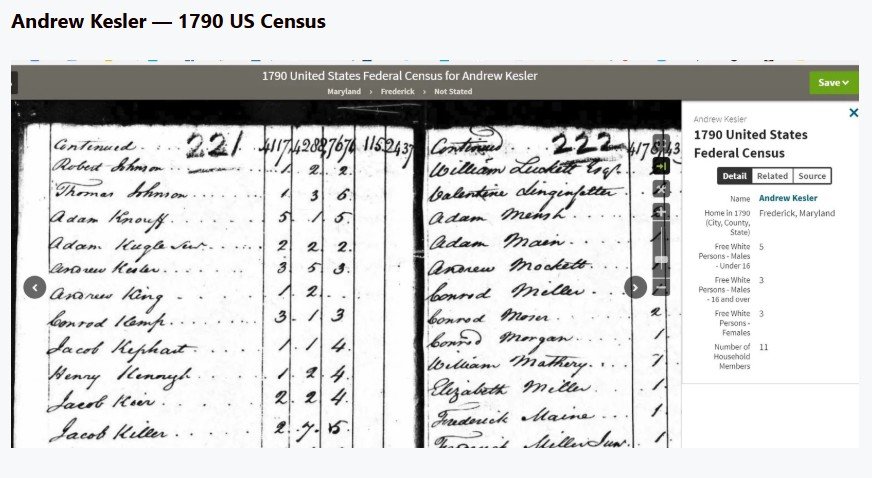
- Andrew Kesler, Frederick County — 5 males under 16, 3 males 16 or older, 3 females
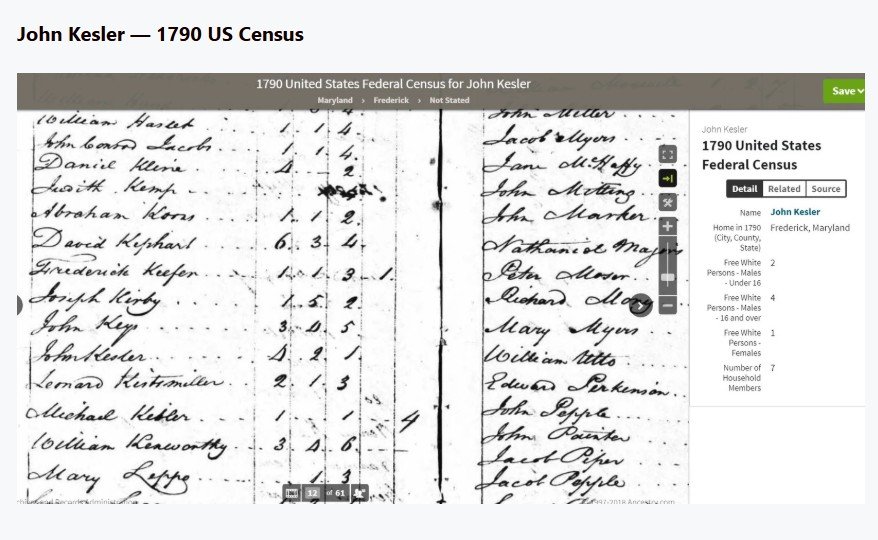
- John Kesler, Frederick County — 2 males under 16, 4 males 16 or older, 1 female
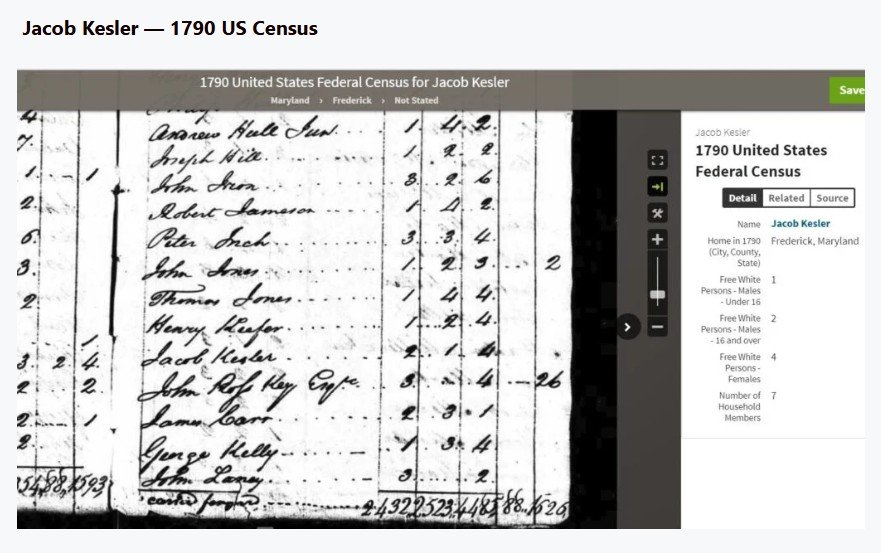
- Jacob Kesler, Frederick County — 1 male under 16, 2 males 16 or older, 4 females
- George Keisler, Frederick County — 0 males under 16, 2 males 16 or older, 1 female
- Mathias Kesler, Washington County — 2 males under 16, 1 male 16 or older, 2 females
The Andrew Kesler household is likely that of Andreas Kessler. The household contained eleven people: three males age 16 or older, five younger males, and three females. Andreas himself would account for one adult male, and his older sons Andrew and Johannes could account for the other two. The household composition is broadly consistent with Andreas and Mary’s growing family, although the census categories do not match the known children perfectly.
The John Kesler entry may represent Andreas’s older brother Johannes. The household contained seven people, including four adult males. Surviving church records indicate that Johannes had married and had children by this period, making the identification plausible, although the household cannot be reconstructed with certainty from the census alone.
The identities of Jacob Kesler, George Keisler, and Mathias Kesler are less certain. They may represent related Kessler households, but no documented relationship has yet been established. Their presence is nevertheless significant because it shows that several families bearing variants of the surname were living in the region by 1790.
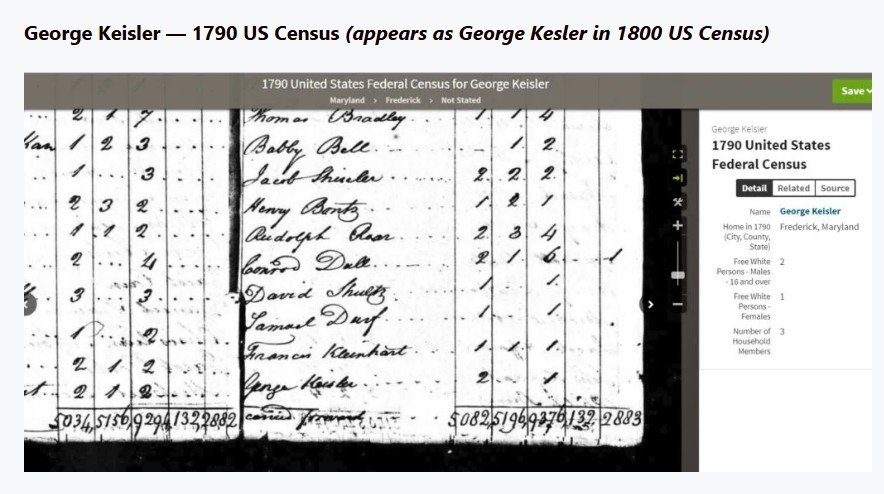
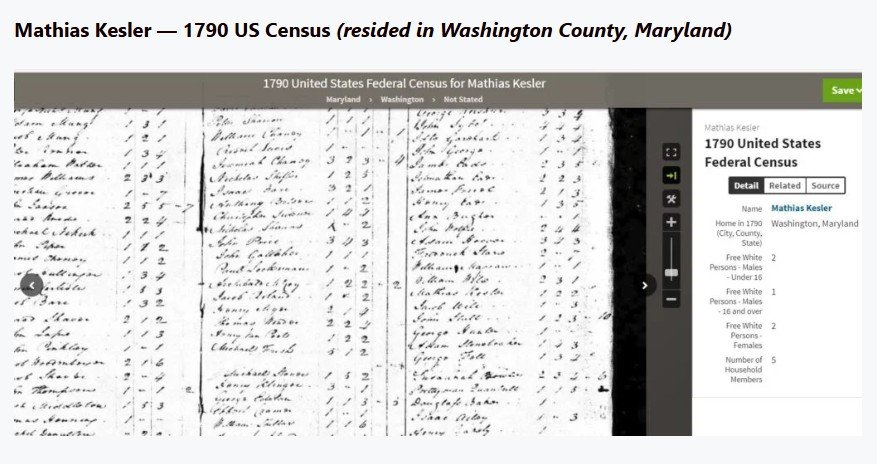
Taken together, the census entries show how much the family landscape had changed since 1751. What had begun as a single immigrant household had become multiple households containing adults, children, and perhaps extended family members. The census therefore captures the family at precisely the moment when land, household formation, and the needs of the next generation were becoming increasingly important — issues that would help shape the decisions made during the 1790s.
Johann's Death in 1792
Johann George Bernhard Kessler died on January 1, 1792, at the age of 80. He had lived in Maryland for more than forty years, long enough to see the family homestead become established, his children reach adulthood, and grandchildren begin a new generation of the family in America.
His death marked an important transition. Andreas was now the senior figure in the family, with adult sons and a large household of his own. The responsibilities that had once centered on Johann increasingly rested with the next generation.
Within only a few years, the family would face another major change. In 1796, Andreas and several sons left Maryland for western Pennsylvania, while other family members remained behind. Johann’s death did not cause that move, but it came at a moment when the family structure was already changing and may have removed one of the strongest ties binding the extended family to the original Maryland homestead.
Western Pennsylvania Opportunities
By the 1790s, western Pennsylvania offered many of the same attractions that had drawn German families into western Maryland a generation earlier: available land, room for expanding families, and the opportunity to establish new farms. Communities were developing in Westmoreland and Fayette counties, and settlers of German background were already moving into the region.
For a family with several adult sons, this mattered. The Maryland homestead could not be divided indefinitely without reducing its usefulness as a working farm. Moving part of the family west offered a way to preserve the original Maryland property while giving younger branches access to new land and opportunity.
The presence of other settlers in western Pennsylvania, including individuals bearing variants of the Kessler/Keslar name, may also have made the region seem less remote and more approachable, although a direct connection has not yet been established.
What May Have Influenced Andreas
No surviving record explains exactly why Andreas decided to leave Maryland in 1796. Several factors, however, may have contributed.
By then he was about fifty years old and had spent nearly his entire life on the Maryland homestead. His father had died in 1792, several of his sons were reaching adulthood, and the family was entering a new generational stage. Additional land would have been increasingly important for sons who hoped to establish households and farms of their own.
Frederick County had also changed dramatically since Andreas arrived there as a child in 1751. What had once been the edge of European settlement had become a more mature agricultural region. Western Pennsylvania, by contrast, still offered the possibility of expansion and a new frontier.
We cannot know how much weight Andreas gave to any one of these factors. His decision was probably shaped by a combination of family needs, land availability, opportunity, and the example of others who were already moving west.
1796: Westward
In 1796, Andreas Kessler and several of his sons left Frederick County, Maryland, for western Pennsylvania. The move ended more than forty years during which the family’s story had centered on the original Maryland homestead.
Not everyone went west. Andreas’s oldest son, Andrew, remained in Maryland and continued the family line associated with the Jefferson Township homestead. Other family members also stayed behind, preserving the family’s long-established ties to Frederick County.
Andreas and the sons who accompanied him settled in western Pennsylvania, where their descendants would form the Keslar and Kesler branches that spread through Westmoreland and Fayette counties and beyond.
A few years later, Johannes “John” Kesler and his family moved south to Virginia, establishing another major branch of the family.
What had begun in 1751 as a single immigrant household had, by the end of the century, become three distinct geographic lines: Maryland, Pennsylvania, and Virginia.
The Maryland Kesslers
Andrew and other family members remained in Maryland after Andreas departed in 1796, continuing the Jefferson Township line.
The Pennsylvania Keslars & Keslers
Andreas and several sons moved west to Westmoreland County in 1796, beginning the Pennsylvania branches of the family.
The Virginia Kesslers & Keslers
Johannes “John” Kesler followed his wife’s family to southwestern Virginia in the early 1800s, settling in Botetourt County.