European Origins
Germany and Switzerland
Introduction
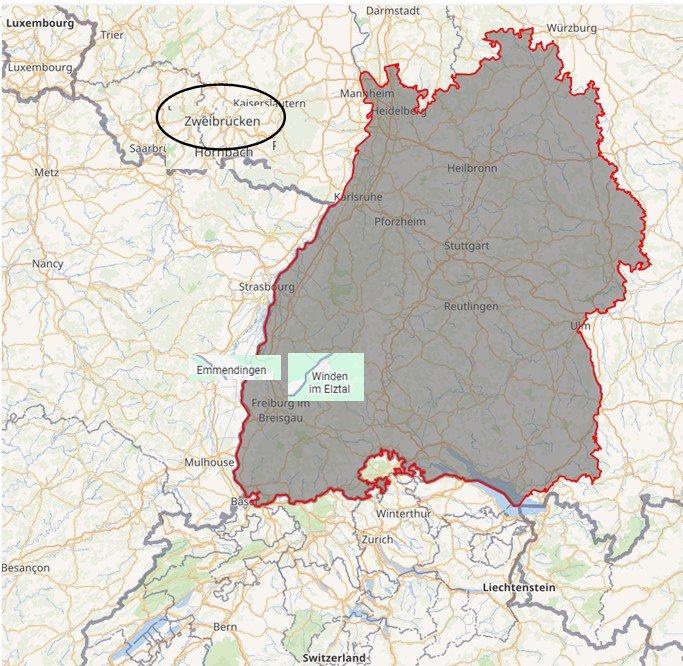
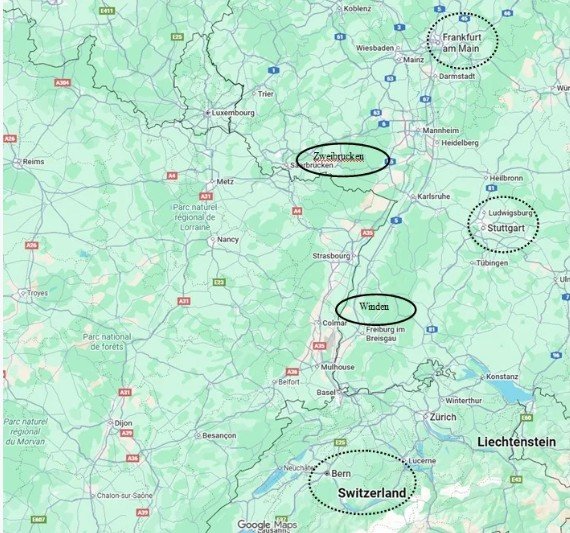
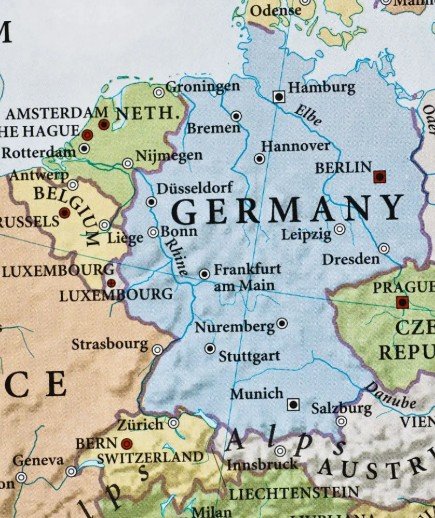
The family story begins in southwestern Germany. Johann Georg Bernhard Kessler and his wife, Anna Catharine Hauswirth, both had deep roots in this region before emigrating to America in 1751. They lived in Winden im Elztal, a small community in the Emmendingen district of southwestern Germany. Winden lies about 60 miles north of Basel, Switzerland, and roughly 110 miles south of Zweibrücken.
The family’s immediate origins in Winden are well established. Earlier Kessler records also appear in Zweibrücken, farther north in the Palatinate. The repeated use of family names across generations suggests a possible connection between the Winden Kessler families and those earlier Zweibrücken lines which extend back to Jacob Kessler in the mid-1300s.
Johann Georg Bernhard Kessler’s wife, Anna Catharine Hauswirth, was born in Winden in 1714. Her family had ties to the area for generations, although the Hauswirth male line came from Switzerland. Her father, Johannes Hauswirth, had roots in the Bern region before relocating to Winden.
Zweibrücken: Historical Context
Zweibrücken was already an established regional center by the Middle Ages. A castle and settlement were documented there by about 1170, and by the 15th century the town had become the capital of the Duchy of Pfalz-Zweibrücken. Kessler-family records appear in the area during this period, making Zweibrücken important to the family’s earlier history.
The region, however, was repeatedly disrupted by war. Zweibrücken was conquered and badly damaged during the Thirty Years’ War and suffered further destruction during the later French conflicts of the 17th century. These upheavals are important to the family story because they may help explain gaps in surviving records and possible movements of Kessler families within southwestern Germany.
By the early 18th century, people throughout the broader Palatinate had endured decades of warfare, economic hardship, harsh winters, and poor harvests. These conditions contributed to large-scale German migration to the American colonies. Thousands left the Rhine Valley region in search of land and better economic prospects, creating a migration pattern that would later include the Kessler family.
Use the following links to learn more about the forces that shaped life in the region:
Kessler History in Zweibruecken
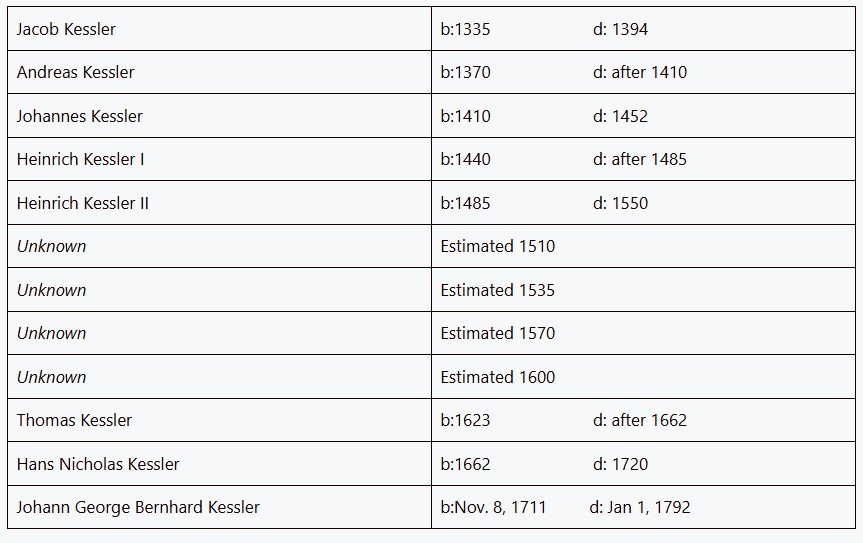
Johannes Kessler was born in approximately 1410 and died after 1452. He was Zweibruecken mayor as of October 16, 1452. His father was Andreas Kessler, who was born in approximately 1370 and is mentioned in an April 3, 1394 document as a son of the deceased Jacob Kessler (1335 – 1394) also of Zweibruecken. Johannes married a von Menger of lower nobility status. This family had considerable real estate in the surrounding vicinity. The ancestry of the von Menger scion can be traced to A.D. 1190 because of its prominence.
Johannes Kessler fathered Heinrich Kessler I who was born in 1440. He was a goldsmith and also served as mayor of Zweibruecken. Heinrich I fathered a son, Heinrich Kessler II (1485 – 1550). At this point we have a four-generation gap in ancestral knowledge dating from Heinrich II to Thomas Kessler, who was born in 1623 (see table below).
During the Thirty Years’ War from 1618 to 1648 Zweibrücken was conquered and destroyed. This period was followed by the French reunion wars when the town was battered and once again seriously destroyed and occupied by the French until the peace agreement of Rijswijk in the year 1697. This could explain the genealogical gap and a potential reason why the family relocated from Zwiebrücken to Winden, the town from which our ancestors emigrated in 1751.
The documented family line resumes with Thomas Kessler who, as noted above, was born in 1623 in Ilbesheim, Mulhofen, Germany. Thomas was the grandfather of George Bernhard Kessler. Thomas’ wife (George Bernhardt’s grandmother) was also a Kessler, but from a different and unrelated family bearing the same surname. Research on this female Kessler line has been traced back to records dating to about 1190 and is linked to considerable prominence in Medieval Europe. As it turns out, our family scion stems from two different, apparently unrelated Kessler families, both with historic roots in the Palatinate region of southwestern Germany.
Thomas had at least two sons, Thomas and Hans Nicholaus Kessler (1662-1720). Hans Nicholaus is our direct ancestor and was Johann George Bernhard Kessler’s father.
European Generations
Derivation of Kessler Family Name
Research has yielded two possible explanations of the family surname, one related to occupation and the other to geography. The name is essentially Germanic in origin, although it is found quite frequently in other parts of Europe including Switzerland and Russia.
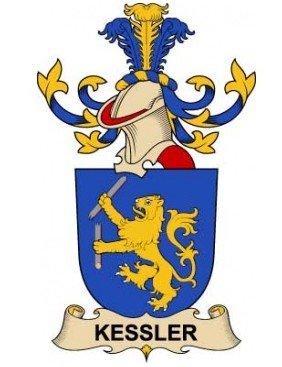
In the first instance the name is occupational, being one of the surnames based on the profession pursued by the original bearer. As such, the name derives from the Old High German word “chezil” which gave birth to the Middle German word “Kessel” meaning “copper.” The name “Kessler” was potentially derived from “Kessel” which means “coppersmith.” Thus, the original bearer would have been employed in this way. During the Middle Ages, before the advent of industrial development, such a skill would have been much sought after and held in particularly high regard in the community.
Alternatively, the surname may be of local origin, derived from a geographic area and used by those with a strong association to that area. There are several towns named Kessel located in Germany and Switzerland. The word “kessel” denotes a hollowed-out area of land and was the name of settlements that bore that characteristic. The “er” ending in German surnames often denotes “one who hails from” and thus the name simply signifies “one who hails from Kessel.”
According to early records the name dates at least to the thirteenth century. Wernherus der Chesseler lived in the Monastery at Cennenbach in 1251. Erbo Kesseler lived in Strassburg in 1261.
Rhineland-Palatinate Migration to America
Throughout the Nine Years War (1688–97) and the War of Spanish Succession (1701–14), recurrent invasions by the French Army devastated the area of what is today Southwest Germany. The depredations of the French Army and the destruction of numerous cities (especially within the Palatinate) created economic hardship for the inhabitants of the region, exacerbated by a rash of harsh winters and poor harvests that created famine in Germany and much of northwest Europe; however, the more specific background of the migration from the Palatinate, as documented in emigrants’ petitions for departure registered in the southwest principalities, was impoverishment and lack of economic prospects.
The migrants came principally from regions comprising the modern German states of Rhineland-Palatinate, Hesse, and northern areas of Baden-Württemberg along the lower Neckar. During the so-called Kleinstaaterei period when this migration occurred, the Middle Rhine region was a patchwork of secular and ecclesiastical principalities, duchies, and counties. No more than half of the so-called German Palatines originated in the namesake Electoral Palatinate, with others coming from the surrounding imperial states of Palatinate-Zweibrücken and Nassau-Saarbrücken, Baden, Hesse-Darmstadt, Hesse-Homburg, Hesse-Kassel, the Archbishoprics of Trier and Mainz, and various minor counties.
What triggered the mass emigration starting in 1709 of mostly impoverished people was the promise of free land in the American Colonies. In 1711 the Colony of Carolina had promised the peasants around Frankfurt free passage to the plantations. Spurred by the success of several dozen families the year before, thousands of German families headed down the Rhine to England and the New World. Because of the concentration of Palatine refugees in the colonies, the term “Palatine” became associated with German. Until the American War of Independence ‘Palatine’ henceforth was used indiscriminately for all ’emigrants of German tongue’.
Although the largest Palatine migration began decades before Johann Georg Bernhard Kessler left Germany, those earlier emigrants helped establish a well-known route from the Rhine Valley to the American colonies. Their experiences, letters, and reports of available land would have been part of the broader environment in which later families such as the Kesslers considered emigration.