From Jefferson Township, Md. to Donegal, Westmoreland County, Pa.
Quick Links
Video coming soon!
Excel Family Database
Frederick Maryland History
Comment or Share
Generation 2 | Ref. Identifier: 1.3
1.3 Andreas Keslar
b: 27 Sep 1746 Winden, Germany
d: 24 Sep 1809 Westmoreland County, Pa.
1.3a Anna Maria ‘Mary’ Rehman
b: 23 Feb 1752 Jefferson, Md.
d: 16 Dec 1840 Westmoreland County, Pa.
Andreas Keslar
Andreas - a pivotal figure on our family history
Andreas fathered a large number of male children who are the ancestors of most of us who are his descendants. At the age of 50, only four years after his father died, he uprooted his life, traveling with a number of his children and their families from Jefferson, Maryland to Westmoreland County, Pennsylvania.
Why did he decide late in life to make the harrowing journey over difficult trails and tracks into what was then the American wilderness? Why did some of his children go with him and others remain behind?
Andreas and Mary had ten sons and a daughter, with the first born in 1770 and the last in 1801. By the time Andreas decided to move to Donegal in 1796, the ten children who were alive at that time ranged in age from six to 26 years old. Some were already married and had families of their own. It is impossible to know what dynamics existed in the family in the mid-1790s.
At some point, when Andreas made the decision to relocate, the decision could have been shared with his children, discussed rationally, with each being asked whether they wanted to accompany him or remain on the family farm in Jefferson. Alternatively, the decision could have been acrimonious, provoking strong emotions including resentment and anger among the children, with some supporting their father’s decision and others objecting to it.
What we do know is that Andreas’ oldest son, Andrew remained in Jefferson, along with his daughter Mary Showe, who was married at the time, Jacob, who was 14 years old, Samuel, who was 10 years old, and David, who was just six years old. It is curious that Andreas and Mary would leave six-year-old David behind, but records indicate that he lived and died in Frederick County. This suggests that each child was given a choice, including even the youngest children.
Four other sons, George, age 20, Peter, age 18, William, age 12, and Thomas, age 8, went west with Andreas and Mary. Johannes, or John, was 24 years old in 1796. He had married Nancy Waskey in 1794. Nancy’s family-owned farmland very close to the Kessler farm in Jefferson, along present-day Landers Road. John and Nancy may have traveled to Westmoreland County to help Andreas get settled before heading south to join Nancy’s mother in Botetourt County, Virginia. It is more likely that they remained in Frederick County and traveled to Virginia from Jefferson. This issue and John and Nancy’s travels and resettlement to Botetourt County, Virginia are discussed in detail in the chapter devoted to John and his family.
John Newton Boucher in his 1906 book: “History of Westmoreland County Pennsylvania, Volume I” noted the following: “Among the old families was the Kistler family, the father, Andrew coming from Germany to Maryland, and then moving to Donegal Township in 1796. Other early settlers were Andrew Harman, who was killed by the Indians; William R. Hunter, the Millhofs, Virsings, Shaeffer, Havses, Gettemys, Jones and Blackburns.”
Homesteading Andreas and his sons and their families arrived in Donegal in 1796 and proceeded over the next several years to erect one or several living structures and buildings to house animals, cleared the land and planted, harvested and sold crops, as the family had done for many years in Jefferson, Maryland. We can imagine Andreas instructing, as his father had done to he and his brother, his own sons, George, Peter, William, and Thomas who traveled with him to fell trees or dig wells. Mary likely guided the women and grandchildren as they made domestic arrangements related to their new homes, prepared for winter, and did whatever else needed to be done to ensure the family was safe and settled.
Andreas survived for 15 years after relocating to Donegal, passing on September 24, 1809.
1746 to 1769 Andreas’ Early Years
Imagine what it must have been like to be a young boy of 4 or 5 years old, living in southwest Germany, and to have your life uprooted by your parents. Andreas’ journey began with a 275-mile coach ride from the family home in Winden to Amsterdam, Netherlands, a trip that likely took about a week to complete. From there Johann and Catharina and their four children boarded the Janet, a typical mid-18th century mast-rigged sailing ship. They were accompanied by Catharina’s 25-year-old brother Johann Jacob Hauswirth. After over a month on the high seas, the ship arrived in Philadelphia on October 5, 1751.
For Andreas, walking off the confining sailing ship after over a month and into a bustling colonial port city must have been both exciting and frightening. The sounds and smells of Philadelphia’s wharfs and downtown offered a variety of stimuli for a young boy. At the same time, most people with whom the family interacted spoke a language that he did not understand, and he likely clung close to his parents and siblings.
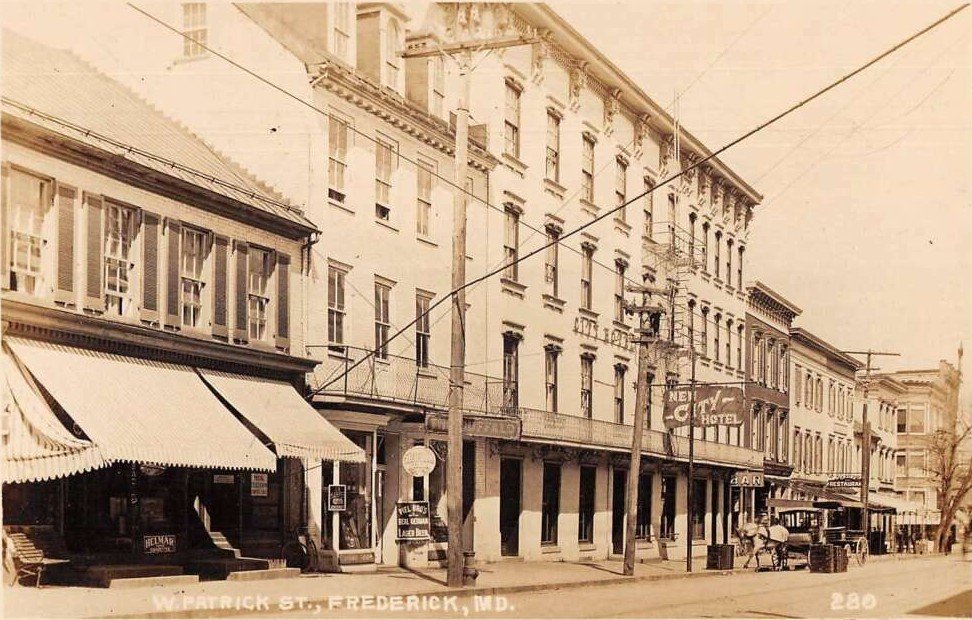
From Philadelphia, the family traveled to the area in Maryland that would become their permanent home, initially staying with relatives while establishing their own homestead. George Bernhard’s cousin, Frantz Weiss, a blacksmith and son of Jacob Weiss and Anna Margaretha Kessler, was born in 1705. He and his brother Abraham had immigrated to the British colonies in 1733, settling first in Lancaster, Pennsylvania, and then relocating to “Tasker’s Chance,” Frederick County, Maryland. Tasker’s Chance later changed its name to Frederick. Frantz was naturalized here on May 3, 1740, under the name Francis Wise.
The French and Indian War raged along the Appalachian Mountain frontier and beyond from 1754 until 1763. The French had constructed a series of forts from Canada to what is now Pittsburgh and, with their native American allies, were destroying settlements, killing settlers and threatening the American colonies. Much of this fighting occurred in western Pennsylvania where Andreas and his family would relocate several decades after the end of the French and Indian War.
While we have little direct information about these years, it is likely that Johann, John and Andreas worked together on the family farm in Jefferson. As the years went by the family likely attended church together, planted, tended, and harvested crops, and transported them into Frederick Town to sell to shop owners and millers. They likely had large numbers of egg-laying chickens, cows, and pigs.
In many ways, given the insularity of the German community and the relative remoteness of the farm, the family was isolated from colonial governance and events. German language newspapers and news obtained at church likely kept the family informed of events that were occurring in Boston and throughout the seacoast that were creating increasing resentment against King George.
As England decided to keep a standing army in the colonies, and imposed taxes to pay for French and Indian War debt and the cost of maintaining its colonial-based military, resentment continued to grow. It is likely that the Kessler family was aware of enactment of the Stamp Tax in 1765 and the Townsend Act duties in 1767, and viewed these actions with the same perspective that many other revolutionaries throughout the colonies viewed them.
Andreas married Anna Maria ‘Mary’ Rehman in November 1768 at age 22. This likely prompted him to build his own residence on the family farm so that he and Mary would have sufficient privacy from other family members. He was 23 years old as the 1760s ended, and he and Mary were about to start their family.
1770 to 1789 Raising a Family
The next 25 years were pivotal both in terms of Andreas and Mary, and the American colonies. While the Kessler family continued to farm, as children were born and raised, a violent revolution raged throughout the British colonies. As colonial leaders declared their independence from British rule, Britain braced itself to suppress the rebellion, sending more troops and ships to the colonies. The Kessler family did not engage directly in revolutionary activities. This likely was because of location and the insularity of the German community in the Frederick and Jefferson areas.
Frederick was an important stop along the migration route that became known as the Great Wagon Road, which came down from Gettysburg and Emmitsburg and continued south following the Appalachian Valley into western Virginia. It also was a route west to Hagerstown and Cumberland and the Ohio Valley. The British garrisoned a German Hessian regiment in the town to control travel.
Andreas and Mary delivered five children during the 1770s and another four over the next 10 years. They would even have another son in 1801, for a total of 11 children — 10 males and one female – concluding four decades of childbearing. All but one of the children were born in Frederick County, on the Jefferson farm.
1790 to 1796 A Changing World
This period is important because, after the British were defeated and the colonies attempted to form a new government, Andreas’ views about the change in governance, economic conditions, and the continued and rapid growth in Maryland were formed. The years under the Articles of Confederation were likely difficult from an economic perspective. The ensuing debates over the proposed Constitution likely caused Andreas to form opinions about whether he preferred a strong central government, as favored by some, or a nation where state governments had more primacy over decision-making and laws. Many farmers in the period 1789-1793 were strongly opposed to adoption of the U.S. Constitution and feared that Alexander Hamilton and the Federalists would form a strong central government that would work against the interests of farmers and rural Americans.
The 1790 US Census is difficult to interpret in terms of who was living where and with whom, since only the head of household is listed. The other family members are included according to gender and age. In those times, it is likely that married children might still have been living at home, working on the farm, or that cousins or orphaned children could be living with family members or grandparents.
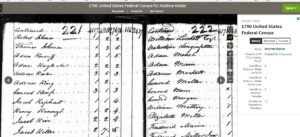
Here is a list of names from the 1790 Census, taken in April 1791, for Jefferson Township in Frederick County, Maryland:
1790 US Census
You can see that there is an Andrew Kesler, likely Andreas on p. 34. There is an entry for John Kesler on p. 12 and a John Fessler on p. 38. Others include Jacob Kesler pm p.20, George Keisler on p.41, and George Kepler on p. 48.
Andreas’ children in 1791 were: Andrew 21, John 19, Mary 17, George 15, Peter 13, Jacob 9, William 7, Samuel 5, Thomas 3, and David 1. So, it is unlikely that any of them are listed in the 1790 census, since they would not have been old enough to have the children listed by the names above. Could John Kesler, age 19, on p. 12 be married to Nancy Waskey and operating a nearby farm? Could his father Johannes who was still alive in 1790 be one of the males over age 16? Could Andreas’ oldest sons be living on John’s farm, working as farm hands? That could explain the discrepancies in some of the numbers of males and females of different age groups. It is simply not possible to understand the circumstances that existed in 1790.
Situation in 1790 When First U.S. Census was Conducted
After breaking from England, the American colonies adopted the Articles of Confederation on March 1, 1781 which created a weak central government, hindering the ability to repay war debts, conduct interstate commerce, and stimulate economic growth. Consequently, during the summer of 1787, state representatives at the Constitutional Convention in Philadelphia drafted the U.S. Constitution, and after lengthy debate, it was ratified by June 1788. The new Constitutional government commenced on March 4, 1789. Land on the Potomac River bordering Maryland and Virginia was designated to be the new federal government location, and Washington, D.C. was founded on July 16, 1790.
The Kessler family, residing in Jefferson, a small community located six miles west of Frederick, Maryland, was certainly aware of these events and the potential consequences, both in terms of how the new nation would be governed, its politics, and the proximity of the new national capital to their community, which was located only 50 miles to the west, closer to Frederick than they were to Baltimore, Maryland, which was located 65 miles east.
Article 1 Section 2 of the U.S. Constitution called for an “enumeration” of the population to determine how many representatives each state could send to the House of Representatives. Congress enacted the 1790 Census Act, which governed census taking until 1840. The first U.S. Census was conducted on August 2, 1790 by the U.S. marshals. Every household was visited, and the completed census was then posted in public locations such as on courthouse doors so that citizens could review and verify that the information was correctly recorded.
Literacy rates in 1790 at the time of the first U.S. census were surprisingly high, ranging from 70 to 90 percent. Literacy was higher in cities than in rural areas. Devout families valued literacy as a means of reading the bible.
Literacy was an important census data accuracy factor. If the person whom the census-taker interviewed was not literate, the census-taker could only rely on the phonetic enunciation of family names. Since the U.S. marshals conducted the early census’, it is also possible that the census-taker had limited literacy.
The compound issues of trying to correctly record the spelling of names based only on how they sounded to the listener, and modest education levels of the census-takers themselves, created significant potential for census errors. Hence the Kessler surname was recorded at different times as Kessler, Keslar, Kesler, Kefler, Kepler, Fessler, Hessler, and Keisler. Some writers tended to shape the letter “s” as an “f” because they placed a slash through the middle of the “s.” Similarly, a slanted letter “s” with a slash through it can easily be mistaken for the letter “f.”
During the period after Johann and Anna Catharina and their children first immigrated, the family likely spoke German in the home. Over time, however, the children and grandchildren were less likely to speak German than were their parents and grandparents. The Kessler family literacy levels of the earliest generations are not known.
It is likely that as the sons reached adulthood they focused on purchasing additional farmland, building their own homes, and expanding the family’s farming efforts. During the 1770s and 1780s Andreas, who married Anna Maria Rehman (Mary) in 1769, fathered nine boys and one girl. The role of farmer and father likely kept him busy and only tangentially focused on the activities that occurred during the 1770s and 1780s.
This information is relevant to our genealogical history because these factors likely played into Andreas’ decision, in 1796, to move to western Pennsylvania. His father died in 1792 and this likely made Andreas long for the past, when Jefferson was considered the wilderness and most of the colonial population was clustered along coastal cities and towns. He might have resented that the area where he settled was no longer as remote as it was when he was growing up and sought to relocate to a less-developed area.
Perhaps his motives were political. The Germans were fiercely independent and resistant to being controlled by government authorities. In 1796 George Washington completed his second term as President. In the 1796 election John Adams, a Federalist who advocated a strong federal government defeated Thomas Jefferson who advocated a restrained federal government and who was an advocate for farmers such as Andreas. The Residence Act of 1790 had determined that the emerging federal government would be located on the banks of the Potomac and not far from Frederick, Maryland. It is entirely possible that Andreas resented what was happening, spurring his decision to relocate to the frontier.
In the Official Poll of the Presidential Election of 1796 Andrew Kessler’s name appears as a voter, substantiating his appearance in the Census of 1790. He is listed as a Federalist which is the same party as George Washington and Alexander Hamilton. I believe that this is Andreas’ son (also listed in this census are Andreas’ other sons, Jacob and John). It is possible that Andreas and his son Andrew had substantial disagreement over the election which might partially explain why he and some of his children accompanied Andreas to western Pennsylvania while Andrew and others did not.
In 1783, a deed was recorded in Springhill, Westmoreland County, Pennsylvania in the name of Petter Keslar, obviously not Andreas’ son, Peter, who was born in 1778. Could this have been one of Andreas’ cousins or nephews? Is it possible that Petter returned to Jefferson and described the wildness and opportunity available on what was the western frontier at that time? Certainly, this could have been a catalyst for causing Andreas to begin thinking about relocating. Perhaps as the Revolutionary War concluded and America fumbled its way toward a constitutional government, Andreas became more convinced that he and his family should escape the chaos of a newly forming republic and start over in western Pennsylvania.
We can never know for certain what factors drove Andreas to give up his home of over 40 years or how he convinced a large number of his sons to travel 150 miles northwest of Jefferson with him to western Pennsylvania. We also have no way of knowing how he learned about Donegal Township in Westmoreland County, Pennsylvania. Perhaps he had relatives who had explored the area and returned to tell him about opportunities in that area. In the 1790s, western Pennsylvania was still a wilderness. There were few developed roads and just years before Indian attacks were still common.
John and Andreas’ father, Johann George Bernhard died in 1792. A few years later Andrew and some of his children and their families relocated about 150 miles northwest to Donegal Township, Westmoreland County, Pennsylvania in 1796. Donegal Township is located in Westmoreland County about 50 miles southwest of present-day Pittsburgh. He lived and farmed in Donegal Township until his death in 1809.
Andreas was a member of the Evangelical Reformed Church. He is buried in the Keslar Family Cemetery located near Salt Lick Township, Fayette County, Pennsylvania.
Why Did Andreas Kessler Move from Frederick to Donegal in 1796?
Westmoreland County is located about 150 miles from Frederick, Maryland so it was no small decision to relocate from the family home of almost 50 years to the western wilderness that was to eventually become the Pittsburgh area. Roads were non-existent at the time and consisted of old Indian trails that had been somewhat widened when the British Army traveled to the region to fight the French and Indian War in the 1760s. So, the decision to make the move was significant.
When Andreas Kessler arrived in what would become Jefferson Township, Maryland in 1751, he was a child of six, growing up on what was then the western edge of settlement in Frederick County. Over the next four decades, Andreas witnessed the transformation of the region from frontier farmland into a settled, regulated agricultural community. By the 1790s, the conditions that had once drawn German families westward—abundant land, relative autonomy, and opportunity for expansion—had largely disappeared from central Maryland.
By 1796, Andreas was in his early fifties, and his sons had reached adulthood. The family faced a common dilemma among long-established German-American farming households: land that had supported one generation could not easily sustain the next. Inheritance customs among German settlers typically favored preserving the integrity of the homestead rather than subdividing it beyond viability. As a result, families often adopted a dual strategy—retaining one branch on the original farm while assisting other sons in establishing themselves elsewhere.
Not all members of the family relocated. Andrew Kessler, the direct ancestor who remained in Frederick County, likely represented the stabilizing branch of the family. By remaining on the homestead, Andrew preserved the family’s original landholdings, community ties, and local standing. His decision reflects not reluctance but pragmatism—an acknowledgment that prosperity could be maintained through continuity just as effectively as through expansion.
Taken together, the partial migration of the Kessler family illustrates a broader pattern among German-American settlers in the late eighteenth century. Rather than abandoning their origins, families adapted to changing economic and demographic realities by dividing risk and opportunity across generations. The westward movement of Andreas Kessler and several of his sons in 1796 was thus not a rupture, but an extension of the same frontier logic that had first brought the family to Maryland forty-five years earlier.
1796 – The Journey to Western Pennsylvania
It is clear that Andreas and his sons Johannes, George, Peter and William relocated from Frederick to Donegal Township, Westmoreland County, Pennsylvania in 1796. John Newton Boucher in his book: “History of Westmoreland County Pennsylvania, Volume I” noted the following: “Among the old families was the Kistler family, the father, Andrew coming from Germany to Maryland, and then moving to Donegal Township in 1796. Other early settlers were Andrew Harman, who was killed by the Indians; William R. Hunter, the Millhofs, Virsings, Shaeffer, Havses, Gettemys, Jones and Blackburns.”
The Kessler family’s westward relocation in 1796 also occurred during a period of profound political transformation. With the adoption of the United States Constitution and the consolidation of federal authority under President George Washington, central Maryland—situated near the emerging national capital—was increasingly shaped by new systems of taxation, courts, and governance. While there is no evidence that political ideology alone prompted the move, the growing presence of centralized authority likely reinforced the appeal of western Pennsylvania, where land remained abundant and daily life was less constrained by distant institutions.
It is within this context that Andreas Kessler and several of his sons relocated to Donegal Township, part of the expanding western settlements of Pennsylvania. This movement was not an act of desperation but a calculated decision shaped by opportunity. By the mid-1790s, western Pennsylvania represented a “second frontier”: land was still affordable and fertile, communities were forming, and earlier waves of settlers—many of German descent—had already established churches, roads, and markets.
The likely route of travel, Braddock’s Road, underscores the deliberate nature of the migration. Originally constructed during the French and Indian War, the road had become a principal artery for westward movement, used by families relocating with livestock, tools, and household goods. Such journeys were often undertaken in kinship groups or along known settlement corridors, suggesting that Andreas and his sons may have followed neighbors or acquaintances who had already made the move.
1796 – The Journey to Western Pennsylvania
Donegal Township is located in Westmoreland County about 50 miles southwest of present-day Pittsburgh. Westmoreland County is located about 225 miles from Frederick, Maryland so it was no small decision to relocate from the family home of almost 50 years to the western wilderness that was to eventually become the Pittsburgh area. The Appalachian Mountains impeded western progress, but roads dating to the French-and-Indian War in the 1750s were still viable and became easier to use as more and more heavily laden Conestoga wagons headed west.
Donegal Township in Westmoreland County and Salt Lick Township in Fayette County are located near each other and about 50 miles southeast of present-day Pittsburgh. During the late 1700s this region was still a wilderness, and settlers often were attacked by Indians. Even though the French and Indian War took place in the 1760s at Fort Duquesne near Pittsburgh, Indian tribes continued to resent infringement by the settlers and would often attack, kill and burn settlements. Here is an example of a description illustrating this point: “In the later years of the eighteenth century small colonies of pioneers settled in the Ligonier Valley near Fort Palmer, Fort Ligonier and Donegal township. These were troublous times because the restless savages were a constant source of danger and the people built their cabins within easy reach of the forts and blockhouses to which they were compelled to flee for refuge from the turbulent Indians.”
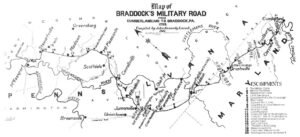
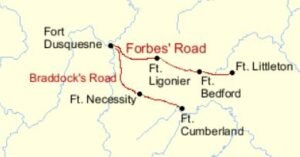
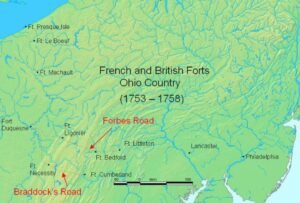
It is likely that Andreas traveled along Jefferson Pike from Jefferson to nearby Harpers Ferry. From there, his entourage likely traveled 140 miles on the Potomac River to Wills Creek in Cumberland, Maryland, the start of the Braddock Road. From there the family used Braddock’s Road, a narrow road that ran from Cumberland, Maryland through the Cumberland Gap to present-day Brownsville, Pennsylvania, to reach its destination. Braddock’s Road was the first road to cross overland through the entire Appalachian Mountain Rand, and for the first-time horse-drawn wagons were able to travel into the West.
Interestingly, early Catholic families from County Donegal, Ireland landed at New Castle on the Delaware River south of Philadelphia and took Braddock’s Road by way of Cumberland to Jacob’s Creek near Connellsville, Pennsylvania. It is likely that Donegal Township was named by these early settlers.
General Braddock’s Military Road Map
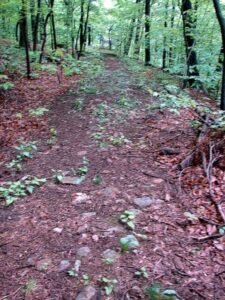
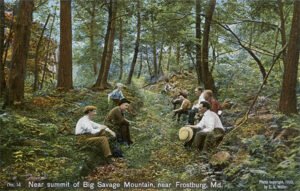
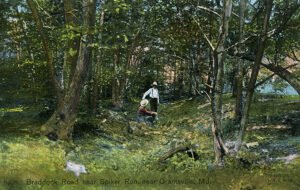
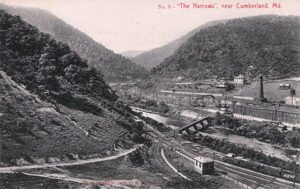
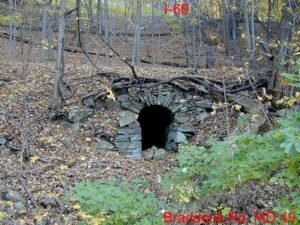
You can see, based on the following Braddock’s Road photos, some taken in the early 1900s, how challenging it was in 1796 to travel to the frontier wilderness. The last photo in the series shows the passage through Cumberland Gap, which enabled horse-drawn wagons to avoid the dangers of traveling directly over the Appalachian Mountains.
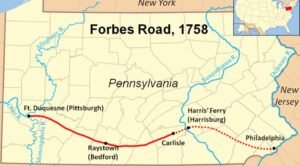
It is possible that Andreas and company did not use Braddock’s Road through Cumberland, although that would have been the most direct route, especially if they were able to use barges to navigate the Potomac River. They could possibly have used a more northerly route, traveling on Forbes Road, also built at the time of the French and Indian War in the 1750s. Forbes Road went through Carlisle, Shippensburg, and Bedford, and provided a more direct route through Pennsylvania compared to Braddock’s Road.
In 1792, the Pennsylvania Legislature established the Philadelphia and Lancaster Turnpike Road Company. The legislation specified the general route and engineering standards. Two years later, in 1794 the Lancaster Turnpike opened to traffic at the going rate of a penny a mile, depending on the number of horses and the size of the wagon. So it is entirely possible that Andreas’ group traveled along this road as far as it went at the time, and finished the journey along the older, unimproved section of Forbes’ Road.
Forbes Road from Philadelphia
Here is an excerpt by Beverly Whitaker (2006), describing the start of the journey west along Forbes’ Road, using a stagecoach. “Leaving from Philadelphia at 2:00 a.m., the Lancaster stage traveled 33 miles to reach Downing Mill by nightfall. The second night the traveler reached Lancaster, another 33 miles.”
It is possible that Andreas and family purchased Conestoga wagons in Lancaster, 97 miles to the north of Jefferson, for the harrowing journey. The following narrative explains why they were preferred for difficult overland travel. It is also possible that once the family arrived in western Pennsylvania and set up their homesteads, they could have sold the wagons to families who planned to travel farther west when the reached Westmoreland and Fayette counties.
“The German craftsmen at Lancaster and other towns in the Conestoga Valley were proud of their work. They had designed their huge wagons with bodies shaped like lazy, inverted rainbows to carry their produce to market in Philadelphia. Although the rigs were so heavy that six husky horses were required to pull them, they couldn’t be constructed any other way, for it took the toughest oak to keep the vehicles from being shaken apart–as many less-well-made wagons were. Then, too, the hickory-spoked wheels, lofty as a man’s shoulder, were especially built not only to withstand the most jarring boulder, but to carry the wagon above the tree stumps which studded all but the most frequented roads.” –Douglas Waitley, Roads of Destiny
1796 to 1809 – Homesteading in Western Pennsylvania
1796 to 1809 – Homesteading in Western Pennsylvania
Childhood Memories It is easy to imagine that arriving at a new homestead in Westmoreland County, Pennsylvania in 1796 brought distant memories back to Andreas of arriving in Frederick County, Maryland when he was 6 years old. The land was likely just wilderness acreage, covered with trees and with limited open space. Perhaps, as his father did almost 50 years earlier, the family took lodging in Donegal Township, commuting back and forth to the new farm until some land was cleared and basic structures were erected. Or perhaps the family circled their Conestoga wagons on the new land and set up camp, sleeping in the wagons, huddling around campfires as the weather turned cooler, rising early and going to bed late while preparing the new homestead.
Donegal Township, Westmoreland County, Pennsylvania
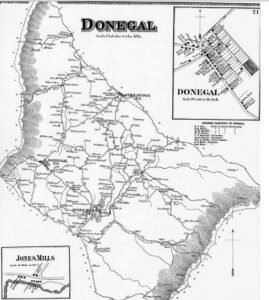
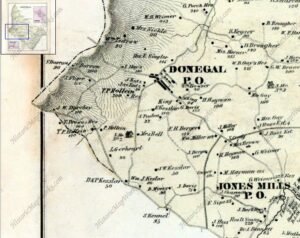
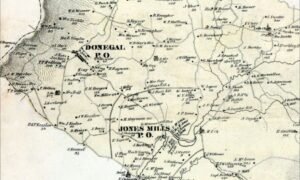
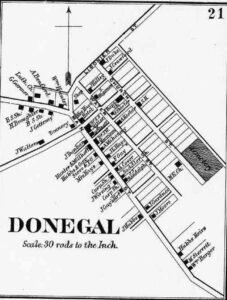
Included below is a map of Donegal Township from 1876. There are numerous listings of relatives on this map who are mostly children of Peter Kessler and grandchildren of Andreas, including William J. Keslar, J. W. Kesslar, and E. Kessler. One of the maps has an insert of Donegal Township and one of the homes in the town is labeled A. Keslar. Many are buried in the Keslar Family Cemetery located in Fayette County, Pennsylvania. There is also a road in the area named Kessler School Road which is named after William and his involvement with the local school district in the mid-to-late 1800s.
The names on the maps including William J. Keslar, J. W. Kesslar, and E. Kessler are likely the children of Andreas’ son Peter. William J. Kessler was born in Donegal on Oct. 20, 1817 and died in 1876. Agnes Kessler was born in 1805 but her death year is not known. She could also be the A. Keslar living in town in 1876. J.W. Kessler is John Wesley Kessler, Peter’s grandson and William J. Kessler’s son, born in 1845 and 31 years old at the time the map was made.
Donegal Twp., Westmoreland Co., PA 1876
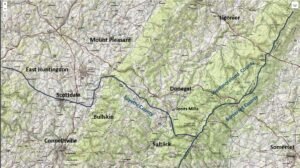
Westmoreland and Fayette County Location Donegal Township in Westmoreland County and Saltlick Township in Fayette County border each other and are about 50 miles southeast of present-day Pittsburgh. By the mid-1790s the region was still a wilderness, but threats from Indian attacks had moved farther west into Ohio.
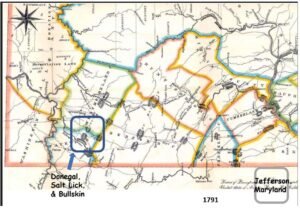
The following maps show the location of Westmoreland and Fayette counties. Donegal township is located very close to Saltlick in Fayette County, as is Bullskin, explaining why the Keslar/Kesler families were located across these three communities. As can be seen in the last two images, there is a Keslar District located in the Saltlick borough of Fayette County.
1791 Pennsylvania Map (above)
A book titled: The Transformation of Western Pennsylvania 1770-1800 (p. 47) describes the area:
Two border townships, Donegal in Westmoreland and Bullskin in Fayette, had smaller figures (speaking of amount of per capita acreage ownership) than might have been expected. Both, in spite of their mountainous terrain, had small clusters of compact settlement that altered their expected pattern. The Donegal settlement clustered around Fort Ligonier and stretched southward along the narrow Ligonier Valley. There were only sixty-one taxable individuals in the township, and most were small landowners. The western tip of Bullskin Township extended beyond the mountains and contained most of its early settlers. As a result of these rather intensive settlements, the largely mountainous townships had smaller holdings than other border townships.
How did the Western Pennsylvania Kessler family become Keslar and Kesler?
Although there is no clear record of how the name evolved from Kessler to Keslar and Kesler, there are a number of likely reasons:
Illiteracy. The early ancestors were farmers who could not read or write. Farming ability was valued more than formal schooling.
Accented English. Andreas and Mary likely spoke more German than English, and when asked their surname, communicated it with accented English.
Phonetic Recording of Surnames. Varying skill levels among census takers. Initially, starting with the first U.S. Census conducted in 1790, the census was done by U.S. Marshalls. Employees likely had varying degrees of literacy and writing styles and many would phonetically spell the names as they were communicated to them.
Handwriting clarity. Schools often taught a very flowing cursive handwriting style, where the letter S was frequently extended and could easily be mistaken for the letter F. In other cases, some census takers recorded census data in very clear, legible hand while others used a less clear style. In some cases, names are recorded in a very light pen or pencil and are very difficult to read.
Translation from handwritten to digital format. This clearly was not a cause of name changes from Kessler to Kesler or Keslar, but readers should be aware when using the census records that many mistakes were made when digitizing census data because records were difficult to read, deciding which letters to record depended on the discretion of those doing to conversion, and in some cases, the conversion was done in a careless manner. The original and digitized versions of US census records cannot be corrected.
Article 1 Section 2 of the U.S. Constitution called for an “enumeration” of the population to determine how many representatives each state could send to the House of Representatives. Congress enacted the 1790 Census Act, which governed census taking until 1840. The first U.S. Census was conducted on August 2, 1790 by the U.S. marshals. Every household was visited, and the completed census was then posted in public locations such as on courthouse doors so that citizens could review and verify that the information was correctly recorded.
Literacy rates in 1790 at the time of the first U.S. census were surprisingly high, ranging from 70 to 90 percent. Literacy was higher in cities than in rural areas. Devout families valued literacy as a means of reading the bible.
Literacy was an important census data accuracy factor. If the person whom the census-taker interviewed was not literate, the census-taker could only rely on the phonetic enunciation of family names. Since the U.S. marshals conducted the early census’, it is also possible that the census-taker had limited literacy.
The compound issues of trying to correctly record the spelling of names based only on how they sounded to the listener, and modest education levels of the census-takers themselves, created significant potential for census errors. Hence the Kessler surname was recorded at different times as Kessler, Keslar, Kesler, Kefler, Kepler, Fessler, Hessler, and Keisler. Some writers tended to shape the letter “s” as an “f” because they placed a slash through the middle of the “s.” Similarly, a slanted letter “s” with a slash through it can easily be mistaken for the letter “f.”
During the period after Johann and Anna Catharina and their children first immigrated, the family likely spoke German in the home. Over time, however, the children and grandchildren were less likely to speak German than were their parents and grandparents. The Kessler family literacy levels of the earliest generations are not known.
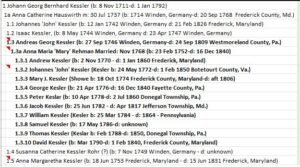
b: 25 Jun 1782, Frederick County, Md. d: Aft. 1824, Frederick County, Pa.
1.3.7 William Kessler (wife: Nancy Slater)
b: 25 Mar 1784, Frederick County, Md. d: 1864 Donegal Township, Pa.
1.3.8 Samuel Kessler
b: 17 May 1786, Frederick County, Md. d: unknown
1.3.9 Thomas Kessler (wife: Mary Polly McAfee)
b: Feb 1788, Frederick, Maryland d: 1850, Donegal Township, Pa.
1.3.10 David Kessler (wife: Aramantha ‘Ann’ Merser)
b: Mar 1790, Frederick County, Md. d: 1 Feb 1840, Frederick County, Md.
Despite extended and fairly heroic efforts, no additional information about Anna Maria “Mary” Rehmen Kessler could be located. Extensive effort was expended, but since she was born in 1752 and there were very few newspapers or government institutions at that time and since most business transactions were done in the male family member’s name, no additional information could be located.
———————————————
[1] There is some confusion about Andreas’ actual birth year. There are baptismal records stating that he was baptized in Winden, Germany on 2 Oct 1746 and his sponsors were Andreas LaHoy, manager of Zweibrücken Compound and Anna Maria, widow of David Fitzinger. This is the same year indicated in the Keslar Family Bible. His tombstone, however, in the Keslar Family Cemetery, Fayette County, Pennsylvania states that he was 65 years old at death on 24 Sep 1809, which would make his birth year 1744..




 1791 Pennsylvania Map (above)